Cloth Diapers 101

Pair text with an image to focus on your chosen product, collection, or blog post. Add details on availability, style, or even provide a review.

Button Label

Talk about your brand

Wool School — Cloth Diapering Basics

Cloth Diaper 101: Understanding Diapers, Absorbency, and Wool Covers


Maybe a friend mentioned wool covers and you're not sure whether to take them seriously.
Maybe you started researching cloth diapers, found a thread full of acronyms, and quietly
closed the tab. Maybe you tried cloth before and it felt like too much laundry, too many
pieces, or too many rules.


You don't need to know any of this before you start. Once you strip away the terminology,
cloth diapering is actually pretty simple.

A diaper has two jobs

Every diaper system needs to do two things:

Absorb moisture.

Keep that moisture contained.


Sometimes those two jobs happen inside one product. Sometimes they're separated into an
absorbent diaper and an outer cover. Understanding that one difference makes everything
else in cloth diapering much easier to follow.

The main types of cloth diapers


There are a lot of names, but most cloth diapers fall into a few basic groups.

Flats


A flat is a large piece of absorbent fabric that you fold around your baby.
Simple, inexpensive, easy to wash, and quick to dry — different folds let you
place more absorbency exactly where your baby needs it.

Prefolds


Similar to flats, but the fabric is already sewn into sections with extra layers
through the centre. They can be folded around the body or folded into a pad and
placed inside a cover.

Contours


Shaped absorbent diapers without all the snaps and structure of a fitted diaper.
They give you more body coverage than a simple pad of absorbency while keeping
the system fairly simple.

Fitted diapers


Fitted diapers are shaped like a diaper and usually fasten around the waist.
The key difference is that the absorbent material wraps around the entire body
— front, back, sides, and centre — instead of sitting only through
the centre. We call this 360-degree absorbency. A fitted diaper still needs a
waterproof or water-resistant cover over top. This is where wool really shines.

Pocket diapers


Usually a PUL outer shell with a fabric lining and an opening where absorbent
inserts are stuffed inside. Easy to put on once assembled and a common
introduction to modern cloth diapering. The inserts come out for washing, which
helps them get cleaner than if everything were permanently sewn together.

All-in-two diapers


A reusable outer shell with removable absorbency inside. When only the absorbent
portion is wet, you can often replace the insert and reuse the shell for another
change before washing the cover.

All-in-one diapers


The absorbency and waterproof outer layer are built into one piece. Convenient
because there's nothing to assemble, but every layer needs to be washed and
dried together each time.

What is PUL?


You'll see this acronym everywhere in cloth diapering. PUL stands for
polyurethane laminate — fabric that has been bonded with a thin
waterproof layer. Most modern cloth diaper covers and many pocket and all-in-one diapers
use PUL to contain moisture.


It works well. Wool simply approaches containment differently.

Why pair 360-degree absorbency with a wool cover?


This is what we consider one of the premium cloth diapering setups — and it's
simpler than it sounds.


You start with a fitted or similarly full-coverage absorbent diaper underneath. That gives
you absorbency around the body rather than relying only on a strip of material through the
centre. Then a lanolin-treated wool cover goes over top.

The absorbent diaper handles the moisture.

The wool provides the outer layer.

They each have one job — and they can be cared for separately.


That separation has real practical advantages. The absorbency goes straight into your
regular diaper wash without a PUL shell attached to it. Water and detergent move easily
through the fabric, and there's nothing waterproof slowing the drying process. The wool
cover, meanwhile, doesn't need to be washed every time the absorbent diaper does.


That means you invest in really good absorbency underneath and rotate a small number of
wool covers on top.

Does a wool system cost more?


When people first see the price of a wool cover, they sometimes assume the entire
system will be expensive. But you don't need a wool cover for every diaper change.


The absorbent diaper underneath is changed and washed each time. The wool cover is
aired between uses and returned to your rotation. Many families are comfortable with
four to six wool covers. Some use fewer.


Your larger stash investment is the absorbency underneath — which is exactly
where you want it. Instead of buying a waterproof outer for every single change, you
put more of your budget into washable absorbency and reuse your wool outer layer.
Over time, that math usually works out well.

Why full-coverage absorbency matters


Not all absorbency is arranged the same way. An insert or pad concentrates absorbency
through the centre of the diaper. A fitted diaper surrounds more of the body with
absorbent material.


That can be especially important for babies who are heavy wetters, sleep in one
position for long stretches, move a lot, or need dependable overnight coverage.


The absorbency catches and holds the moisture. The wool is the backup and outer layer.
That partnership is what makes the system work so well.


When your absorbency is doing its job, you're not asking the wool cover to compensate
for anything. It's just there as the outer layer — doing exactly what it's
designed to do.

Where Bumby comes in


Bumby makes the wool side of the system. Our covers are designed to go over the
absorbency that works for your family — whether that's a flat, prefold, contour,
fitted diaper, or another cloth system that could use an additional outer layer.


Some families also use wool over a disposable diaper when they want extra coverage,
especially overnight. You don't have to replace everything you already own just because
you want to try wool.

How wool works as a diaper cover


Wool behaves very differently from a laminated waterproof fabric. When treated with
lanolin — the wax naturally associated with sheep's wool — wool becomes
highly water-resistant while keeping all the natural properties that make it such an
interesting fibre.


A properly lanolized wool cover can be aired between uses rather than automatically
going into the laundry after every wet diaper. That's the part that surprises most
people.

Your absorbency gets washed.

Your wool gets reused.

Wool care is simpler than it sounds


Your Bumby cover arrives pre-lanolized and ready to use straight out of the package.


Between normal uses, let it air dry completely before putting it back into rotation.
When it needs a proper wash, machine wash cold on a gentle cycle with a wool-safe
detergent — we use and recommend Unicorn Clean (their heavier-duty wash, designed for cloth diapers). After washing, re-lanolize when
needed and lay the cover flat to dry.


We have separate guides for washing and lanolizing, because once you understand how
the diaper system works, those steps are much easier to learn in context.

How many diapers do you actually need?


This depends on how often you want to do laundry and the age of your baby. For the
absorbent portion, many families start with a dozen or more and adjust from there.
Newborns go through considerably more changes in a day, so a larger stash makes
laundry more manageable.


For wool covers, you need far fewer — because they're rotated rather than
washed after every wet diaper. A starting rotation of four to six covers gives most
families plenty of flexibility.

You can mix diaper systems


There's no rule that says your entire diaper stash has to match. Lots of families
use fitted diapers with wool overnight and pocket diapers during the day. Flats at
home and disposables while travelling. Wool over a system they already own when they
need more coverage.


You can start with one wool cover and see how it fits into your routine. Cloth
diapering doesn't have to become an identity or an all-or-nothing decision. It's just
a collection of tools. The best system is the one that works for your baby, your
laundry routine, your budget, and your life.

Start with the part you want to solve

If leaks are your biggest problem…
Look at your absorbency first.
If your absorbency is working but you want a different outer layer…
Explore wool.
If overnight diapering is the struggle…
Consider full-coverage absorbency paired with a wool cover.
If you have absolutely no idea where to begin…
That's fine too. Start with the basics: absorbency underneath, cover on top.
Everything else is just choosing which version of those two pieces works best for you.


Ready to explore the wool side of things? Bumby covers are designed to work with
whatever absorbency you already love — and every cover ships pre-lanolized
and ready to go.

Shop Diaper Covers


More questions? Head over to our FAQ or
drop us a line at hello@bumbywool.com. We're
always happy to talk through what's going on with your diaper situation.

The Kilt Knew: Why Scottish Men Have Been Right About Summer Wool All Along

Wool Honestly — The Bumby Blog

The Kilt Knew: Why Scottish Men Have Been Right About Summer Wool All Along

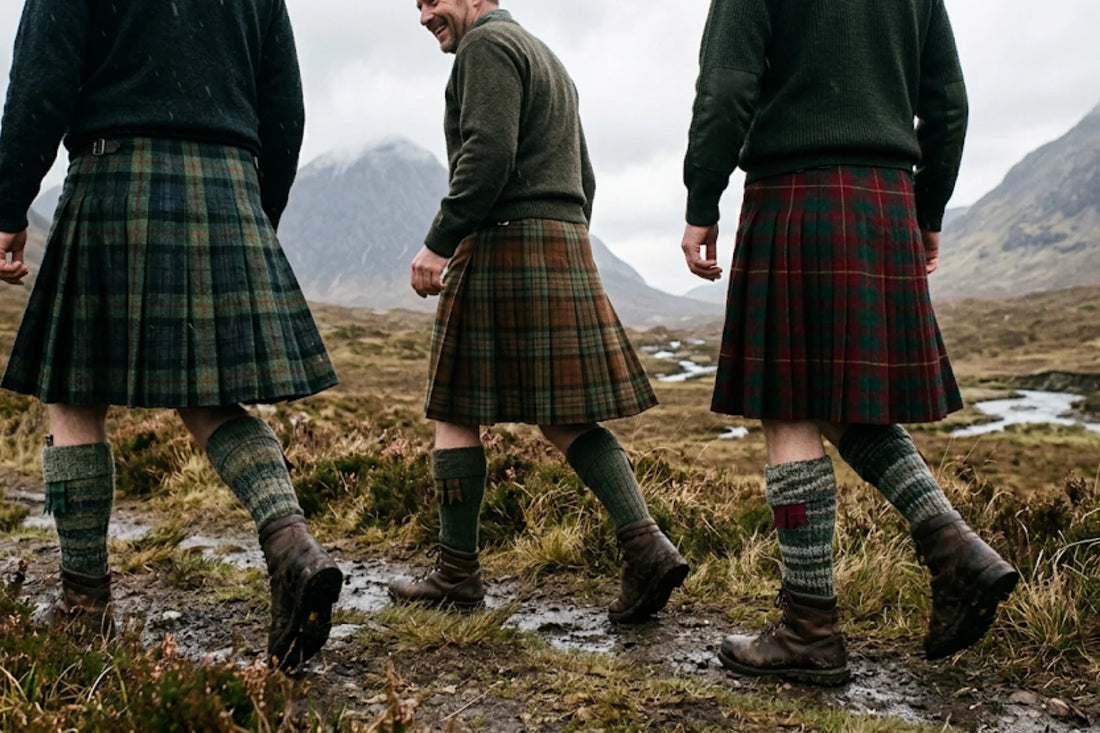
A kilted Scottish gentleman in July, wool compression socks pulled to the knee, impressively ventilated from the waist down, completely unbothered by the heat. It looks like a historical quirk. It is actually a whole summer strategy. And he's been right this entire time.

We have been conditioned to think of wool as a cold-weather material. It is the fabric of survival — heavy sweaters, thick socks, that emergency blanket you keep in the car. Wool is for January. Wool is for when the heating breaks. Wool is decidedly not for July.

And then you look at a kilt.

The kilt is wool. A traditional kilt is made from tartan tweed — a heavy, tightly woven wool fabric. It is also, structurally speaking, a garment that maximizes airflow to the body in a rather direct way. It covers the legs. It moves with the body. It is worn in the Scottish Highlands, where summers are short but genuinely warm, and where the midges make being outdoors in anything tight or synthetic an act of genuine suffering.

The kilt is not a cold-weather garment that Scottish men refused to give up. It is a climate-appropriate solution that has been quietly winning for about five hundred years.

Wool does not trap heat. It manages it.

Here is the thing most people do not know about wool: the fibre is hollow. There is a canal running through each individual strand. In cold weather, that hollow structure traps air and insulates. In warm weather, the same structure wicks moisture away from skin and releases it as vapour. The fibre breathes. It moves humidity out before your body fully registers it as sweat.

This is not a design compromise. This is the actual point of wool. It regulates. It works in both directions. The kilt knew. The highland shepherd knew. The sailor knew. The alpine athlete who swears by merino base layers in July absolutely knows.

Wool is not a cold-weather fabric that tolerates summer. It is an all-season fabric that our collective memory has filed incorrectly.

The wool compression socks are not an accident either

This is the detail that really does it for me. The traditional Highland dress includes wool kilt hose — long socks, pulled up to just below the knee. In warm weather. With a wool skirt. While standing in a field or marching for several kilometres.

That sounds, on paper, like a recipe for misery. In practice, those socks are managing heat and moisture from the ankle up, the kilt is handling airflow and coverage from the waist down, and the whole system is doing what wool has always done: quietly solving the problem the body is presenting, without making a fuss about it.

The modern merino wool sock market — the hiking socks, the running socks, the "blister-proof" long-distance walking socks — is not a new discovery. It is a very old one, repackaged in modern branding and sold to people who have forgotten that their ancestors already figured this out centuries ago.

And then there were the swimsuits

If you need further evidence that wool and summer have always had a relationship, consider the early twentieth century photograph. The one with the bathing beauties at the seaside, standing in wool swimsuits, not looking particularly uncomfortable.

Wool was the original swim fabric. It handled water. It managed body temperature. It dried faster than people expected. It did not go transparent when wet in the way that some of its eventual replacements did. This was not a failure of imagination on the part of our grandparents. This was wool doing what wool does.

A note on chlorine: Pool water is genuinely not wool's friend — chlorine damages the protein structure of the fibre over time. But lakes, rivers, sprinklers, water tables, and rain? Absolutely fair game. Lightweight merino dries faster than most people expect, especially with any airflow in warm weather.

What this means for the rest of us

The kilt is an extreme example, and we are not necessarily suggesting you adopt full Highland dress for the school run. But the principle it demonstrates is real and relevant and chronically underused.

Wool in summer means clothing that handles heat without trapping it. It means natural UV protection — wool typically achieves a UPF of 20 to 50, compared to a cotton t-shirt's UPF of around 10. It means a fabric that neutralizes odour rather than just airing it out, so a long warm day does not automatically require an immediate change of clothes. It means coverage that does something, rather than just existing.

For babies specifically — where temperature regulation is still developing, where skin is sensitive, where you want breathability and coverage at the same time — wool makes a genuinely compelling argument. A Bumby wool cover in July is managing temperature, not trapping it. Same fibre, same cover, same logic as the kilt. Just significantly more leg coverage.

Five hundred years of Highlanders have been telling us this. It might be time to start listening.

The 1000 Hours Outside crowd already knows

The outdoor parenting community, the slow living families, the people who spend genuine time outside in every season — they have mostly already found their way to wool. They wear it for the same reasons the Highlanders did, even if they cannot always articulate exactly why. It just works. It keeps working. It does not require much thought once it is part of the routine.

And frankly, if a five-hundred-year-old garment designed for outdoor life in variable weather conditions is still the right answer, that is not a coincidence. That is a very good fibre, doing what it has always done, waiting for the rest of us to catch up.

Want to read more about what wool actually does at a fibre level? The Wool 101 guide covers the full science — hollow fibres, lanolin chemistry, flame resistance, and why wool has been the answer to every season for centuries.

Read Wool 101 Shop Wool Covers
Volver al blog

Deja un comentario

Tenga en cuenta que los comentarios deben aprobarse antes de publicarse.