How Bumby Wool Made Slow Fashion Scalable Without Selling Out
You can listen to the full conversation on Apple Podcast, Spotify, iHeart, or iVoox.
What if the thing everyone said would kill your business is actually what saved it?
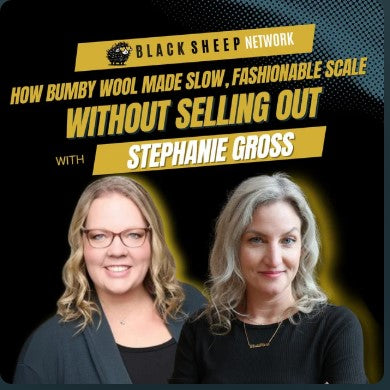
That question sits at the heart of my conversation on The Black Sheep Network, where I had the chance to talk about how Bumby Wool has grown over nearly two decades without abandoning the values that shaped it in the first place.
The episode is called How Bumby Wool Made Slow Fashion Scalable Without Selling Out, and it gets into the real story behind Bumby.
Not the polished version.
The actual one.
The basement.
The kids underfoot.
The first employee who originally came to work with me for free and is still part of Bumby 16 years later.
The years of figuring things out without a traditional business plan.
The strange decisions that did not always look like business strategy at the time, but ultimately became some of the strongest parts of the company.
You can listen to the full conversation on Apple Podcast, Spotify, iHeart, or iVoox.
Bumby Started With a Problem, Not a Business Plan
I did not start Bumby because I had always dreamed of running a fashion company.
I started because I could not find what I wanted, so I made it.
That beginning shaped the way I have approached the business ever since.
Instead of starting with what the market said I should sell, I started by solving a problem.
Instead of trying to build the biggest company possible, I tried to build something that worked for my family, my customers, and eventually the people working alongside me.
Bumby grew from there.
Slowly.
Sometimes awkwardly.
Usually without following the traditional playbook.
And somehow, those decisions became part of our advantage.
Slow Fashion Can Be a Business Model, Not Just a Marketing Phrase
Slow fashion gets talked about a lot, but living it behind the scenes is different from putting the words on a website.
For Bumby, it has meant making products when they are actually needed.
It has meant thinking carefully about waste.
It has meant choosing materials intentionally.
It has meant designing products to last and finding ways to extend their useful life.
It has also meant refusing to accept that mass production is the only way a clothing business can grow.
One of the things we discussed in the episode is the amount of waste that can happen in fashion before a garment ever reaches a customer.
Products can be designed, manufactured, shipped, stored, discounted, and eventually discarded without ever being worn.
Our made to order model gives us another option.
We can make what people actually ask for.
It is more complex operationally, but it also means we are not constantly guessing what thousands of future customers might want and producing mountains of inventory in advance.
For years, people could have looked at that model and said it would make Bumby impossible to scale.
Instead, it became part of what made the business resilient.
I Do Not Spend Much Time Watching Competitors
This was one of the parts of the conversation that seemed to surprise people.
I really do not spend much time looking at what competitors are doing.
That is deliberate.
When you spend all of your time looking sideways, it becomes very easy to start building somebody else's business.
Most of our best ideas have come directly from problems.
A customer asks for something.
A team member notices something.
A process stops working.
A material becomes difficult to source.
A family needs something that does not currently exist.
Then we figure out what we can do about it.
That mindset has allowed Bumby to evolve in some unexpected directions over the years.
It has also kept our focus on the people we are actually trying to help.
The Team Has Always Been Part of the Business Model
My first employee originally came to work with me for free.
She has now been with Bumby for 16 years.
There is obviously a much bigger story behind that sentence, and we talk about it in the episode, but what matters most to me is what happened afterward.
I wanted a business that worked around life because becoming a mom was part of the reason I started Bumby in the first place.
It would have made very little sense to build a company that gave me flexibility and then create a workplace where nobody else had any.
So family came first.
People were trusted.
We figured things out around real life.
We created flexibility wherever we could.
That approach does not always resemble a traditional workforce model.
But people staying for years instead of constantly leaving has enormous value.
Experience stays inside the company.
Knowledge stays inside the company.
Relationships grow.
Trust grows.
Customers benefit from it.
The business benefits from it.
Caring about people and building a profitable business are not opposites.
I think they often reinforce each other.
The Relentless Pursuit of Profit Can Cost You Profit
We also talked about something I feel strongly about.
If profit becomes the only measurement behind every decision, businesses can start destroying the very things that made them valuable.
Employees leave.
Quality slips.
Customers stop trusting you.
Suppliers become purely transactional.
Short term savings create long term problems.
Of course businesses need to make money.
Bumby needs to make money.
But profitability is not only about squeezing as much as possible out of every transaction.
There is value in loyalty.
There is value in staff retention.
There is value in customers who trust you enough to come back.
There is value in building something people want to talk about.
Bumby has earned more than 1,000 five star reviews, and our private Facebook community has grown to around 2,500 people who share ideas, answer questions, help each other, and talk about wool.
That did not happen because we created the perfect marketing funnel.
It happened slowly because people felt connected to what we were doing.
Sometimes Survival Looks Like Rebuilding
Nearly two decades in business means there have been plenty of moments when things did not go according to plan.
COVID was one of them.
Tariffs were another.
There have been supply challenges, family challenges, financial decisions, technology changes, and plenty of moments when the systems that worked for a smaller Bumby simply stopped working for the company we were becoming.
During COVID, I used the pause to rebuild.
That is something I have continued doing ever since.
I am not particularly attached to a system just because we have always used it.
If something stops serving the business or the people using it, we can change it.
Sometimes growth is not adding more.
Sometimes growth is ripping something apart and rebuilding it properly.
Why 2026 Feels Like Our Launch Era
One of the funniest things I said during the conversation was that 2026 feels like Bumby's launch era.
Bumby has existed for nearly two decades.
So technically, the launch happened a very long time ago.
But there is a difference between starting a business and finally understanding everything it has the potential to become.
The last 18 years have been the foundation.
We have learned how our products behave.
We have learned what customers need.
We have learned where our systems break.
We have learned how much the community matters.
We have learned what we are unwilling to compromise.
We have also become much clearer about where Bumby can make the biggest difference.
That is why this stage feels new.
The business is not starting from scratch.
It is starting from 18 years of experience.
Meet Aleasha Bahr and The Black Sheep Network

Part of what made this conversation so much fun was the person on the other side of the microphone.
Aleasha Bahr is the founder and host of The Black Sheep Network and the founder of Black Sheep Sales. Her work challenges traditional sales thinking and focuses instead on building systems around authenticity, fit, and the way people actually want to buy.
So it probably is not surprising that we had plenty to talk about.
The whole idea behind The Black Sheep Network is celebrating people who looked at the conventional way of doing something, questioned whether it actually made sense, and decided to build differently.
That is a conversation I am always happy to have.
Then, because apparently the universe wanted to make the pairing even more appropriate, Aleasha and I discovered we share the same birthday.
October 11.
Two Libras. Two Black Sheep. One microphone.
I think we were destined to have a good conversation.

You can explore more episodes of The Black Sheep Network on Spotify or The Black Sheep Network on iVoox.
Connect with Aleasha: LinkedIn
Learn more about Black Sheep Sales: Black Sheep Sales
You Are Allowed to Build Differently
This is probably the biggest message I hope people take from the episode.
There is no single correct way to build a company.
You can prioritize sustainability.
You can put your family first.
You can treat employees like people.
You can choose quality over speed.
You can refuse to race toward the cheapest possible version of your product.
You can make decisions that other business owners think are strange.
You can change your mind.
You can rebuild.
You can grow slowly.
You can care about profit without making profit the only thing that matters.
And you can still create a strong business.
Sometimes the things people tell you will make your company weaker are the exact things that make it very difficult to compete with.
Listen to the Conversation
If you are building a business, thinking about starting one, or simply curious about what slow fashion and ethical entrepreneurship look like behind the scenes, I would love for you to listen.
The conversation covers nearly two decades of Bumby, including the wins, the strange choices, the hard parts, and the reasons I still believe businesses can grow without selling out the things that made them worth building in the first place.
How Bumby Wool Made Slow Fashion Scalable Without Selling Out with Stephanie Gross