Why Does This Bumby Fit Differently? A Very Long Story About Wool, Stretch and Fit
We have been making Bumby Wool for almost 20 years.
That is a lot of wool.
Over those years, we have used different mills, different knitters, different dye lots and slightly different versions of our fabrics. We have called them Comfy, Cozy, Durasoft, Fuzzy and even Almost Fuzzy.
Why Almost Fuzzy?
So we could shorten it to AF.
You might be wondering if there was another reason.
The answer is no.
Or maybe no.
Honestly, after almost 20 years and that many pallets of wool, some of the historical naming decisions are probably best left unexplored.
We have also had solids, melanges and stripes, plus different generations of each. Today, I mostly lump all of those older fabrics together as Heavyweight, with our newer Brushed Knit separated because it behaves a little differently.
That makes shopping much simpler.
It also hides a wonderfully complicated textile history underneath one very simple word: Heavyweight.
And that history helps explain something we hear occasionally:
Why does one Bumby in the same size feel different from another?
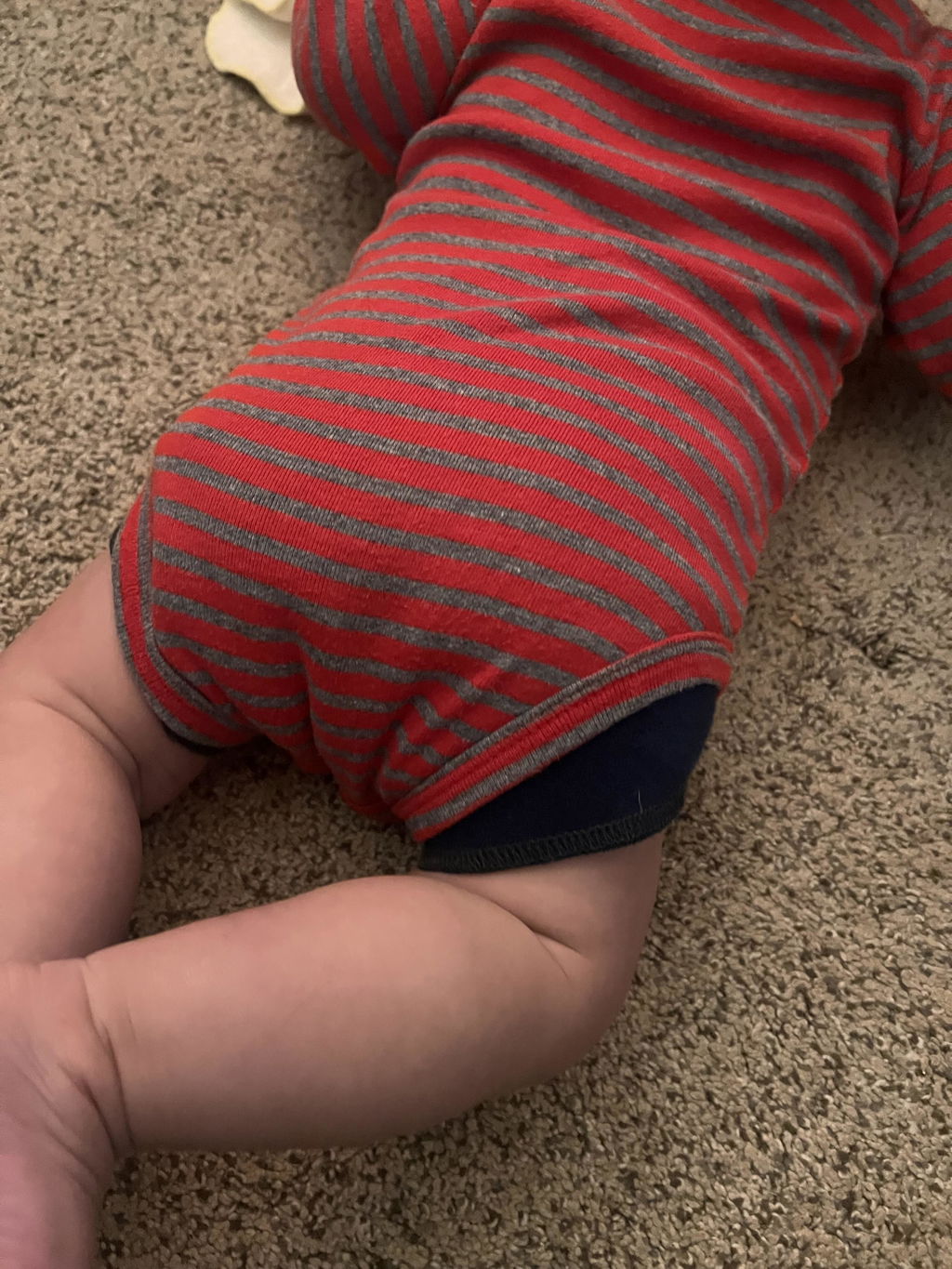
The short answer is that wool is a natural textile, our fabric is made for us in relatively small production runs, and there are a surprising number of things that can affect how a finished piece stretches and fits.
The longer answer is much more interesting.
Our wool isn't pulled off a warehouse shelf
For many years, we have commissioned our own fabric. Our standard fabric is made from 95% merino wool with 5% stretch fibre, rather than simply buying whatever wool happens to be available.
We have also experimented over the years, including briefly using a 97/3 fabric similar to one used by Nature's Fabrics, but our commissioned 95/5 has been the heart of Bumby for a very long time.
The wool fibre is primarily Australian, with some New Zealand fibre, and we have worked with yarn suppliers and textile specialists in Montreal and throughout North America.
Over the years our fabric has been knit in Montreal, New York, Pennsylvania, North Carolina and California.
When I say "commissioned," I mean we commit to the run.
A pallet arrives.
Sometimes three pallets arrive.
Thousands of kilos of wool.
And even at that scale, Bumby is still very small potatoes in the textile industry.
A large knitter may spend a month running fabric for a major customer. Our order might occupy the machine for a day or two. There are also only so many mills capable of making the particular fabric we need.
So sometimes I wait.
And wait.
And politely remind them that I am still here.
Fortunately, I am delightful to work with.
I don't choose from twenty perfect samples
This is one of the realities of being a small manufacturer that people don't always see.
I generally don't receive a giant sample book and choose the exact version of a fabric I want.
I commission the fabric.
They knit it.
The pallet arrives.
Then I find out exactly what that particular run has given me.
Every run can be just a little different.
We've had multiple versions of our melange fabrics. Our brown and white stripe alone has been made several times, and each run has had its own personality.
That's natural textile manufacturing at our scale.
About those stripes
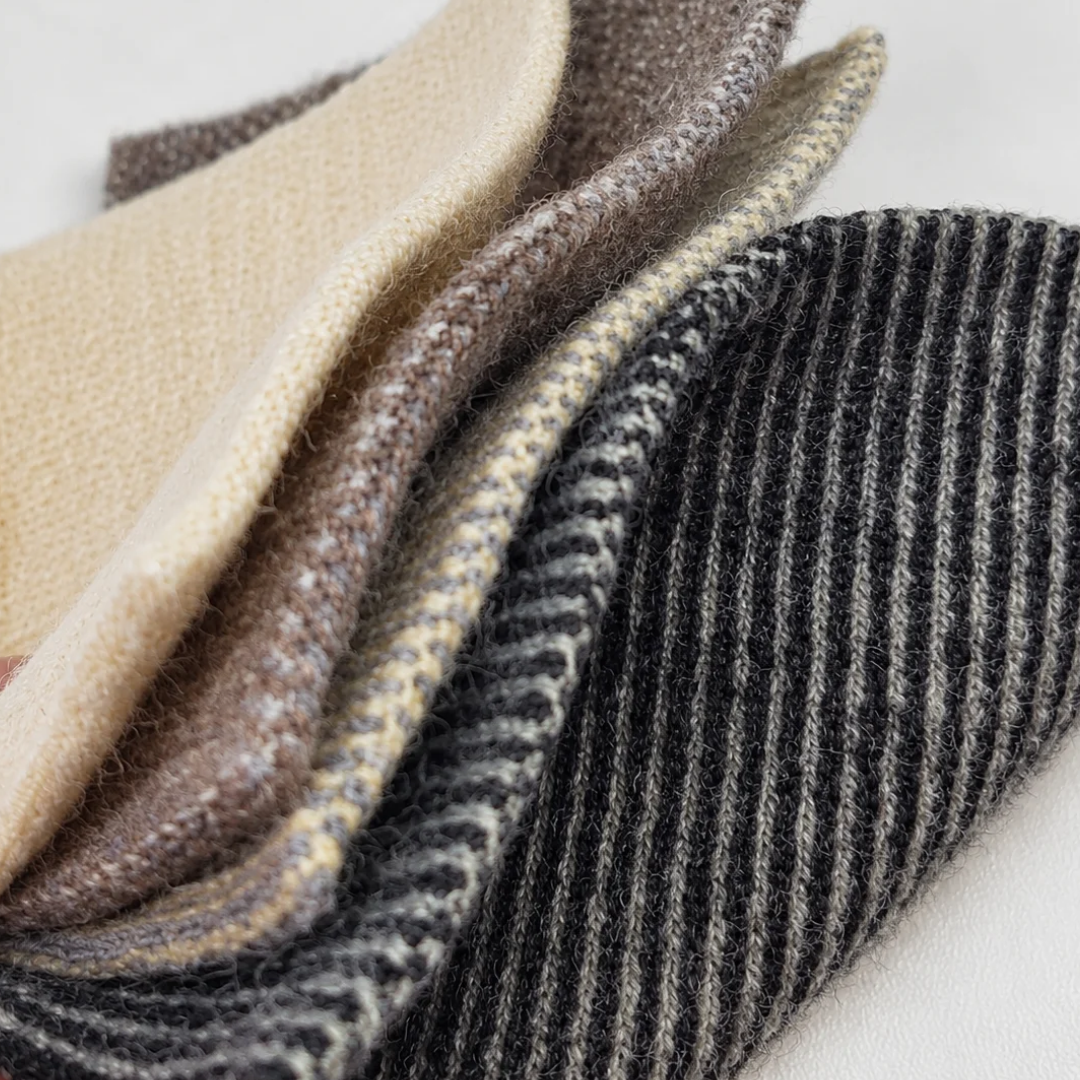
We have three basic striped fabrics:
Tin, grey and white
Twilight, black and white
Biscuit, brown and white
Then I overdye them.
That is how one basic fabric can become all kinds of different Bumby colours while still starting with the same underlying knit.
And here is where things get interesting.
Our striped fabric is not rib knit.
It can look and behave a little like ribbing, but technically it isn't.
On the interlock knitting machine, alternating needles knit the different yarn colours. In Biscuit, for example, you have white and brown yarn alternating through the fabric.
The brown yarn was dyed before knitting. That processing changes it ever so slightly.
Once I dye and felt the finished fabric, those two yarns can react a little differently. Microscopically, they can separate and settle into their own tiny channels.
That can make the fabric look or feel almost ribbed.
But it isn't a rib.
A true rib knit is constructed differently. Our stripe is fundamentally the same type of interlock construction as our other Heavyweight fabrics.
And here's the really important part:
Stripe does not automatically mean stretchier.
We have had striped runs that were stretchier than some solids and striped runs that were less stretchy than some solids.
The colour or appearance alone cannot tell you exactly how that particular piece will behave.
Then along came Brushed Knit
One of our manufacturing changes led to a batch of yarn being knit into a half Milano construction by Emilio, one of the textile people I met through our Montreal manufacturing network.
And I absolutely love what came out of it.
This is the fabric we're now calling Brushed Knit.
Brushed Knit is stretchier than our traditional Heavyweight fabrics. There can still be variation from one batch or finish to another, but as a general rule, if you have a Brushed Knit Bumby, expect it to have more give.
That matters when you're comparing fit.
If you have a Medium Heavyweight that fits one way and then try a Medium Brushed Knit, they may not feel identical on the body.
And get this.
Brushed Knit was made with the exact same yarn we used for Durasoft.
Durasoft was probably the sturdiest, most substantial fabric we ever had. Then we took that same yarn, changed the way it was knit and ended up with our softest, fluffiest, stretchiest version.
Same yarn.
Completely different fabric.
Just for fun. And apparently because wool wasn't complicated enough already.
It is actually a perfect example of why I can't simply say, "This yarn behaves like this," or "This type of wool will fit like that."
The yarn matters.
The knit matters.
The finishing matters.
The dyeing matters.
They all work together to determine what that final fabric feels like and how it behaves on the body.
Then I get my hands on it
We dye our wool ourselves at Bumby.
Not "hand dyed" in the vague marketing sense.
I mean I am actually standing beside an old fashioned top load washing machine with an agitator in the middle, very hot water, citric acid and dye from Dharma Trading Company.
We've been doing it this way for years.
And dyeing creates another variable.
A slightly different water temperature matters. How long a colour takes to set matters. Different colours behave differently. The amount of felting during the process can vary slightly.
One colour may tighten the fabric a little more than another.
Even two pieces that started as the same fabric can come out of the dyeing and finishing process with slightly different stretch.
For years I tried to explain every variation.
Eventually I realized I was making things worse.
People didn't need a textile manufacturing course to buy a diaper cover.
So we simplified.
Heavyweight.
Brushed Knit.
Colour.
Size.
And if you want to nerd out about exactly which generation of Biscuit you own, just ask me. Apparently I have retained an unreasonable amount of information about wool.
Construction isn't the variable
There is an important distinction here.
We hand dye, hand cut and hand sew our products in our shop.
There are four of us working on this team, and we've been doing this for years. My first employee is still here 17 years later.
Krista can cut a stack of pieces and they are incredibly consistent.
So when two Bumbies feel slightly different, we're generally not talking about one being randomly cut much larger than another.
We're talking about the behaviour of the fabric itself.
That is one of the realities of working with natural fibres and small batch textiles.
Before you decide something is too small
This is the part I really want people to know.
Wool is incredibly forgiving.
Our wool has stretch, memory and the ability to relax with warmth and wear.
It is also a little bit "sticky."
Wool fibres have microscopic scales. Add lanolin and the surface doesn't slide over another fabric the way a pair of cotton pants might.
Sometimes when you're pulling a wool cover over a diaper, it catches a little.
That resistance can make you think:
This is too small.
But once you actually get the cover into place, the wool warms against the body, relaxes and settles.
Give it a moment before deciding the fit is wrong.
And if it really is a little snug, you still have another trick.
You can block your wool
Blocking has been used with wool for generations.
The name comes from the old practice of stretching wet wool over wooden forms or blocks to establish its shape.
When wool is wet, it can stretch far more than most people realize.
Normally, we tell you to lay wool flat to dry because we don't want gravity stretching it. Hanging a wet wool garment can pull on the fibres and leave you with stretched shoulders or a garment that becomes longer than intended.
But you can use that same property deliberately.
If the waist or cuffs of your Bumby feel a little snug, rinse and spin the garment and gently stretch the area while it is wet.
You can use whatever appropriately sized household object works for the area you're trying to stretch. I've seen people get very creative with containers, water bottles and even cookie sheets.
If the wool is already lanolized, turning it inside out while blocking can help keep the lanolin where you want it.
Shape it.
Let it dry flat in that shape.
That's blocking.
And yes, it really can make a noticeable difference.
So before you sell your Medium and buy a Large, try blocking the Medium.
Otherwise you may buy the Large in a slightly different knit or dye lot, discover that it behaves differently, and wonder what on earth is going on.
What if your Bumby has stretched too much?
We can use the same wool behaviour in the opposite direction.
If a garment has relaxed more than you'd like, some warmth can help it rebound.
I've done this myself with Mama Pants that became too relaxed through the thighs. Warm or even quite hot water brought them back beautifully.
Our wool has already survived some fairly intense conditions in my dyeing process. I use extremely hot water when dyeing it.
That does not mean I recommend routinely washing your Bumby in boiling water.
For regular washing, I prefer a cold machine wash.
Cold water is gentler on the colour and gives you fewer opportunities for dye bleeding. Wool dyes perform best in acidic conditions, while detergents tend to move wash water in the opposite direction.
If I'm intentionally using warmer water to encourage a garment to rebound, I may add a small amount of citric acid or vinegar to help reduce colour bleeding, then wash or rinse it appropriately afterward.
And what about the dryer?
The dryer can also encourage a stretched piece to rebound, but I wouldn't make it part of your regular routine.
The issue isn't simply "wool can't go in the dryer."
Our wool is designed to be remarkably washable.
The bigger concern is repeated heat and tumbling affecting the seams and the stretch fibre inside the fabric over time.
If I am deliberately using the dryer to help something rebound, I put it in wet and remove it before it is completely dry.
Then I finish it flat.
Think of heat as a tool, not your everyday wool care routine.
A quick note about "itchy" or "sticky" wool
Those microscopic scales on wool are also part of why wool sometimes feels different against skin.
Wool doesn't behave like a perfectly smooth synthetic fibre.
The surface can catch on very dry skin. Some people describe that feeling as itchy. Others notice that the wool simply feels a little sticky or grabby against the skin.
Lanolin adds to that stickiness.
That doesn't necessarily mean the wool is too small or uncomfortable. It can simply mean that the wool isn't sliding freely over the skin or diaper underneath it.
Some people find that the initial itchy feeling also disappears after they've worn the wool for a little while. Those tiny scales can catch onto loose, dry skin, and once that dry skin has sloughed away, the sensation can change.
This is another reason fit can be deceiving when you first pull a Bumby on. Wool doesn't necessarily glide over skin, clothing or a diaper the way cotton pants do.
Sometimes it needs a little help getting where it belongs.
Get everything into place first.
Then judge the fit.
So why don't we explain all of this on every product listing?
Because you would never make it to the Add to Cart button.
There is a balance between transparency and completely overwhelming people.
We work with a natural fibre.
We commission relatively small production runs in an industry built for much larger manufacturers.
We dye it ourselves.
We cut it ourselves.
We sew it ourselves.
We've been doing that for almost two decades.
There are going to be small variations from one generation of Bumby wool to another, and sometimes even between colours from the same generation.
That isn't something we're trying to hide.
It's simply more information than most people need when choosing a diaper cover.
So here is the part worth remembering:
Brushed Knit generally has more stretch than Heavyweight.
Stripe does not automatically mean more or less stretch.
Two colours or generations of Heavyweight can feel slightly different.
Wool relaxes with warmth and wear.
If something feels a little snug, get it properly into place before judging the fit.
If it is still snug, try blocking it before changing sizes.
Washing, wearing, drying, previous use, all of these can change the fit as well. Buying used, how it was cared for...
Also, I have seen "babied. hand washed wool" so dirty wool that could walk out on it's own, and a simple machine was next to new again.
And if you're buying an older Bumby through our Buy/Sell/Trade community and aren't sure which fabric you're looking at, ask the seller for a little more information.
You can also ask us.
I can't promise I will remember the life story of every piece of wool we've used in almost 20 years.
But there is an alarmingly good chance I will.
Not sure whether your Bumby needs a different size, a little blocking or simply a few minutes to settle into place? Reach out to us before giving up on the fit. We're always happy to help you figure out what you're working with.