Before machines, before factories, before spinning mills, there was waulking.
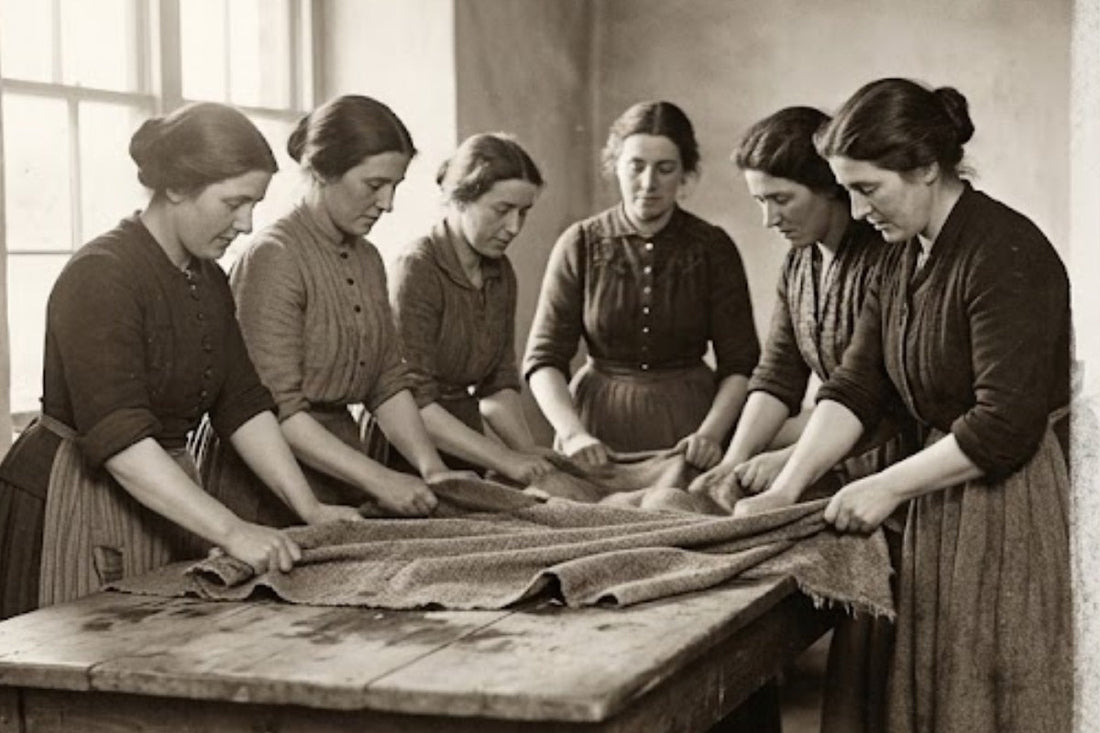
Waulking is a traditional Scottish and Gaelic wool-finishing process. A group of women would gather around a long table with a length of freshly woven tweed stretched out wet between them. They'd pound it with their hands, their feet, sometimes boards, working rhythmically to tighten the weave and make the fabric dense and weather-ready.
Here's the part that doesn't come up in the pretty versions of this story: the cloth was first soaked in stale urine. The ammonia in aged urine scoured the fiber and fixed the dye. During the waulking itself, one woman would walk the length of the shed pouring hot urine from a kettle over the cloth while everyone pulled their feet back from the splashes. Crude jokes were made. The work carried on.
And through all of it, they sang. The waulking songs are some of the oldest surviving folk music from the Gaelic world, call-and-response, passed down through generations, timed to the rhythm of the work. The songs at the start and end were slow and serious. The ones in the middle were quick and jolly. No song was ever repeated in a session, because repeating one was considered bad luck. When the cloth was done the women measured it in finger-lengths to decide if another song was needed. Afterward there was a ceilidh. The men were invited back in.
I think about this when I'm at my worktable. The idea that making something, really making it, used to be this. Communal, physical, a little chaotic, deeply skilled, and genuinely celebrated when it was done.
Bumby is a small operation, but the community around it has always felt like that table.
The wool hasn't changed. The songs are just different now.